
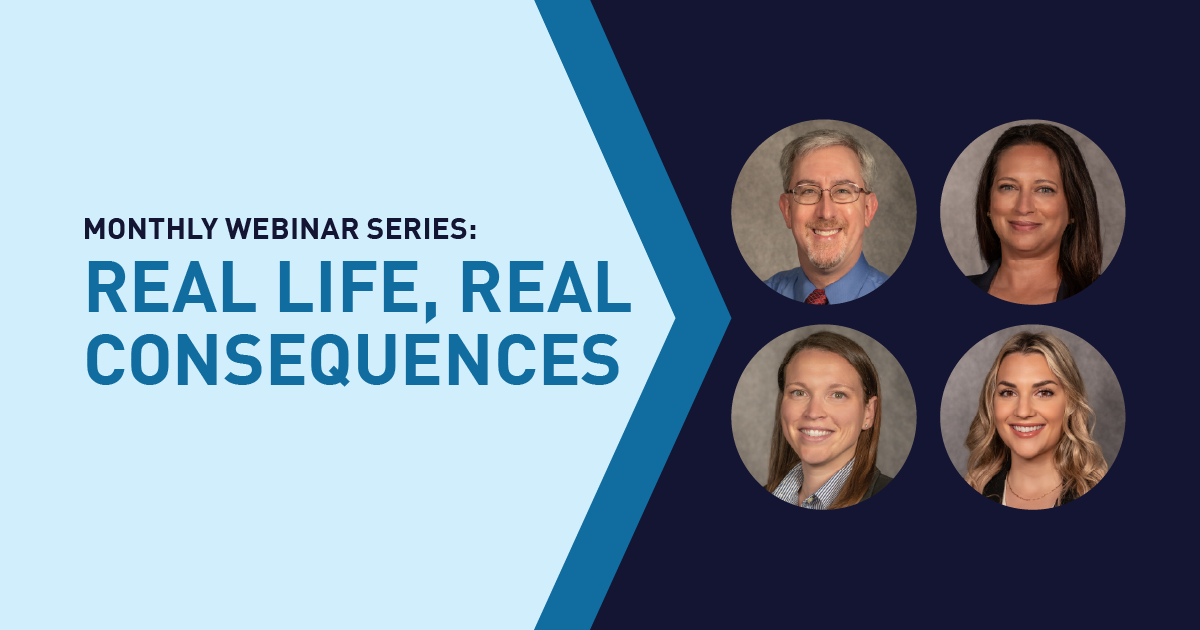
PAR’s Legal Hotline attorneys discussed recent State Real Estate Commission cases that included continuing education, property management, scams and broker responsibilities. Here’s a quick summary of what you might’ve missed.
Continuing Education
Assistant Counsel Paige Perrucci started the webinar by reviewing the continuing education rules. According to the regulations, a licensee shall “complete 14 hours of commission-approved continuing education during the preceding license period.”
In the case she presented, the respondent lived in Florida and completed 14 hours of CE courses in Florida, mistakenly believing they were approved in, or would transfer to, Pennsylvania. They were not, and they did not, so she failed her random audit.
The typical commission sanction for licensees who fail to complete their required credits is $200/credit hour, but in this case, the respondent agreed to a voluntary surrender of license for at least five years (which can be a common sanction for someone who has decided to retire or leave the business).
The lesson here is to make sure the continuing education courses you attend are approved by the Pennsylvania State Real Estate Commission and not just any state. If you haven’t already completed your required 14 hours, there is still time to register for Triple Play (just make sure you double-check that the courses you attend are approved for Pennsylvania CE credits!).
Broker Supervision: Office Locations and Earnest Money Deposits
PAR Chief Legal Officer Hank Lerner went over a case that covers office requirements. A salesperson used an office to do their real estate licensed activity every day: meeting with clients, presenting seminars and conducting closings. The broker was aware of the agent using this space; however, it was never licensed with the state as a main office or branch office. The broker was sanctioned with a $3,000 fine, tacked with $688.72 in investigative costs for failing to provide appropriate supervision and allowing the agent to practice from an unlicensed space.
While on the topic of broker supervision, another case mentioned on the webinar was about a buyer agent mishap resulting in a substantial broker fine. A newer buyer agent received an earnest money deposit from the buyer, scanned a picture to the listing agent as proof of receipt, but never delivered the physical check to the listing agent or broker. The buyer agent’s broker (not the agent) was sanctioned with a $6,000 fine for a failure to supervise. It appears that in this case, the main issue may have been insufficient training of the new agent on their escrow duties, which is why the broker was sanctioned.
Property Management
Assistant General Counsel Desiree Brougher discussed the commission’s recent emphasis on cases related to property management. One of those cases involved an unlicensed individual who created a property management company, which was also unlicensed. This individual, through their company, was managing several units for other individuals, and advertising their services online, saying that they specialize in “property management” and as a “landlord.” They were sanctioned $20,000 plus costs for the investigation, as well as a cease-and-desist order. The takeaway here is that property management must be practiced under the supervision and scope of a brokerage. Oh, and you must be licensed to do property management with a few slim exceptions.
Scams, Scams & More Scams!
Assistant Counsel Kacy Clouser reviewed a case that presented an example of the recent vacant land scams we’ve seen and how licensees could be affected. An agent signed a listing contract for a vacant lot with the property “seller,” who turned out to be a scammer. After being contacted by an attorney from the legitimate owners, the agent took down the listing … but then relisted it several months later after the “seller”/scammer contacted the agent to let them know the issues had been resolved. The agent took no steps to verify this and actually facilitated the sale of the property to a buyer. The agent was found in violation for failing to exercise reasonable professional skill and care and received a sanction of a $5,000 fine (plus investigation costs) and seven hours of continuing education.
There are important red flags to watch out for when listing vacant land. Sometimes there may not be much an agent can do to avoid getting caught up in a scam, but this case shows that licensees who ignore red flags may find themselves in some hot water.
Property Access
The webinar wrapped up with a lesson on property access. In one case, a buyer agent sent their buyers to a property to walk through without the agent – which included providing a lockbox code and information about the seller’s security system. That was a $3,000 fine plus seven hours of continuing education. In the other, an agent scheduled a showing for a buyer who didn’t exist and used the property to create a marketing video for themselves (while leaving “buyer feedback” from the non-existent buyer). This one resulted in a $5,000 fine, plus 10 hours of continuing education. The takeaway implied is that when a buyer agent schedules a showing for a client, both a buyer agent and a client need to exist and show up.
To hear more about the key takeaways from SREC cases, view the webinar recording on PAR’s website.
Topics
Member Discussion
Daily Emails
You’ll be the first to know about real estate trends and various legal happenings. Stay up-to-date by subscribing to JustListed.
