
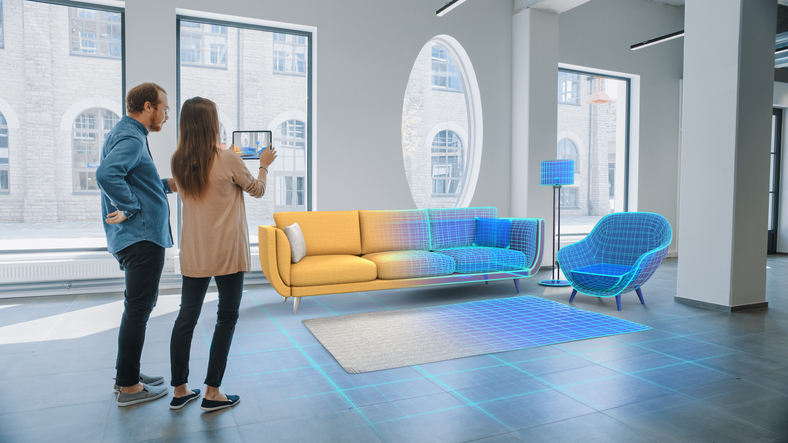
We’re beginning to see artificial intelligence everywhere, and for many Realtors®, that includes AI-enhanced listing photos. How is AI being used to change home listings? And, more importantly, what legal and ethical issues can arise from using AI-enhanced photos?
Realtors® Report Seeing More AI Photos in Listings
PAR asked Realtors® whether they’ve been seeing AI-enhanced photos in home listings, and the common answer was yes.
“I’ve absolutely seen this!” shared Tamara Ruckdeschel, a member of the Lawrence-Mercer Association of Realtors®. “Especially in bathrooms, where something simple like closing the toilet lid, closing the shower curtain and removing clutter from surfaces makes a world of difference. These simple AI adjustments work wonders in all rooms.”
Using AI to close a toilet lid or remove some clutter can be a quick and easy fix, but Realtors® are also seeing other AI enhancements – ones that are a bit more misleading.
“I’ve seen AI photos that eliminate stains in flooring, add fire in non-functioning fireplaces and more,” said Jennifer Burns, a member of the Realtors® Association of Metropolitan Pittsburgh. “It can be deceptive if not checked properly.”
“Most of what I have personally encountered with AI has been related to enhancements in listing photos – things like overly aggressive photo enhancements, altered exteriors and virtual staging that makes a property appear materially different from how it looks in person,” Tricia Como, a member of the Greater Harrisburg Association of Realtors®, commented. “This often leads to buyer frustration and disappointment once they tour the home.”
Todd Van Horn, another member of RAMP, agreed with the frustration surrounding AI-enhanced photos, saying, “It is a frustrating reality in today’s market. There is a massive difference between showing a home’s potential and digitally rewriting its reality.”
“While AI tools have made it incredibly easy to ‘clean up’ a listing, many agents are inadvertently crossing into the territory of misrepresentation by altering the material facts of a property,” Van Horn adds. “In the real estate world, we are permitted to use virtual staging to help a buyer visualize how a room functions with furniture, but that is where it should end.”
Legal and Ethical Concerns
As it becomes easier and easier to generate and use AI-enhanced listing photos, it’s important to understand some of the legal and ethical problems they can lead to.
“While this issue is top-of-mind today because of emerging AI trends, the concepts and standards around photos have been around for decades, and they’re the same as if photos are altered through manual photo editing software,” says PAR Chief Legal Officer Hank Lerner.
“License law prohibits ‘misleading or untruthful advertising,’ while the National Association of Realtors ® Code of Ethics says that Realtors® ‘shall be honest and truthful in their real estate communications and shall present a true picture in their advertising, marketing and other representations.’ If you’re wondering whether a particular photo could be problematic, ask yourself if a reasonable consumer might say that the photo is misleading or untruthful, or if it fails to present a ‘true picture’ of the property in its current condition.”
So what about photos that declutter counters, straighten curtains or add in virtual furniture to illustrate the dimensions of a room?
“Things like minor cosmetic cleanups or virtual staging are likely to be acceptable,” says Lerner. “That said, it may still be appropriate to disclose that certain photos have been edited, and some MLSs may actually have specific rules requiring this sort of disclosure.”
But what about photographs that do things like replace landscaping, knock down interior walls or show spotless roofing and facades that don’t actually exist in real life?
“Photos that mislead consumers about the current condition of the property are potential problems,” Lerner notes. “Even disclosing that a specific photo is a ‘concept’ or that it doesn’t accurately reflect the current condition could be a violation if the marketing materials never do reflect the actual condition of the property.”
Lerner also reminds members that PAR cannot approve any particular advertising or provide members with specific disclosure or disclaimer language. Agents should talk with their brokers about their suggestions for handling these sorts of photographs, and brokers may want to consult with brokerage counsel to consider whether it’s necessary to create a brokerage policy for the use of AI in property advertising.
Topics
Member Discussion
Daily Emails
You’ll be the first to know about real estate trends and various legal happenings. Stay up-to-date by subscribing to JustListed.
