
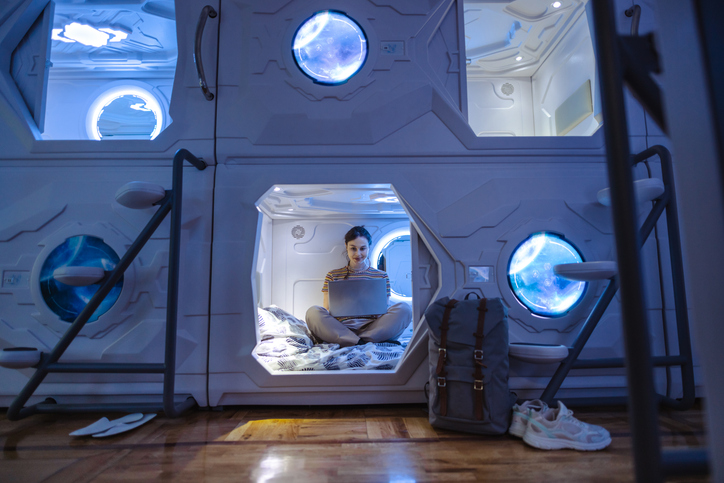
Capsule hotels – also referred to as pod hotels and nano hotels – are abundant in several Asian countries and offer travelers economical, accessible lodging. But will the trend take off in the United States?
What is a capsule hotel?
A capsule hotel is a hotel where each unit is a pod that’s only big enough to accommodate one bed. In Japan, where the capsule hotel originated in 1979, the typical capsule measures around 21 to 32 square feet.
Travelers staying in capsule hotels share a communal bathroom, and the overall design is minimal with a focus on function. Many capsule hotels integrate technology such as high-speed internet, adjustable lighting and charging ports, as well as additional amenities like lockers, vending machines, lounges and more.
What are the benefits?
Capsule hotels are affordable, which is the biggest selling point. In Japan, rates typically range from $20 to $33 per night. This makes travel much more accessible, especially for short-term stays.
Other benefits include:
- Location. Most capsule hotels are located in busy social hubs and large urban centers.
- Privacy. Capsules may offer less privacy than traditional hotels, but they offer more than hostels, making them a better fit for many solo travelers.
- Sustainability. Capsule hotels reduce the physical footprint of each guest, translating to less energy consumption and less need for new construction.
Market Outlook
The global capsule hotel market size was estimated at $292.9 million in 2024 and projected to increase by 8.8% to $432.5 million by 2030, according to Grand View Research.
In North America, Grand View projects that the capsule hotel market will reach a revenue of $45.1 million by 2030.
Factors to Consider in the U.S.
While definitely more popular in Asia, some capsule hotels have popped up in the U.S., including in Hawaii and New York City.
Still, the U.S. differs significantly from Japan in many aspects, and capsule hotels may not gain the same traction here. Some differing factors include:
- Cultural preferences. Americans value space, and the idea “bigger is better” is a commonly held notion. Sleeping in a tiny pod doesn’t appeal to many people, nor does sharing a bathroom.
- Space limitations. The U.S. is geographically bigger than Japan. While denser metro areas may benefit from capsule hotels, the need for them isn’t quite as widespread.
- Building regulations. The U.S. has strict fire safety codes and maximum building occupancy limits that may make building high-density capsule hotels difficult.
- Existing alternatives. There’s already a high saturation of budget hotels and motels in the U.S. – many of which offer the same or better amenities at competitive prices.
Topics
Member Discussion
Daily Emails
You’ll be the first to know about real estate trends and various legal happenings. Stay up-to-date by subscribing to JustListed.
