
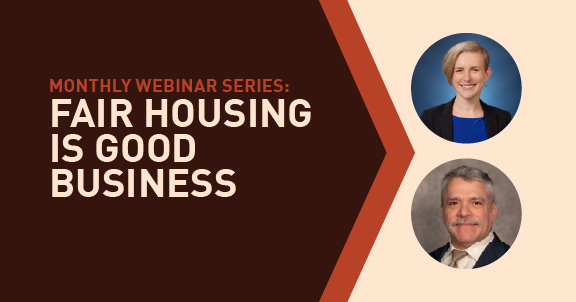
PAR President David Dean discussed expanding housing access and opportunities in Pennsylvania on a webinar this week with Brittany Mellinger from the Pennsylvania Human Relations Commission. Mellinger has been with PHRC for five years and currently serves as the director of fair housing and commercial property.
Here are a few highlights from the webinar.
Fair Housing Laws
“There are several different layers of fair housing laws,” Mellinger explained, emphasizing the importance of upholding fair housing practices from a legal standpoint. “Most real estate professionals are very familiar with our federal Fair Housing Act, which really forms the basis of our fair housing protections. But there are a few other federal laws that folks should be aware of.”
Some of these include Section 504 of the Rehabilitation Act of 1973 and the Americans with Disabilities Act – both of which prohibit discrimination on the basis of disability.
There’s also the Pennsylvania Human Relations Act, which covers discrimination in employment, housing, commercial property, education and public accommodations. The PHRC enforces this, and the act has been amended many times since its adoption in 1955.
“To add an additional layer of complexity onto all of it, there are over 70 different local human relations ordinances in communities throughout Pennsylvania,” she added. “So, some at the borough or city level, and some at the county level. And more of these ordinances are added on every single year.”
Protected Classes
“In addition to our seven federally protected classes – race, color, religion, national origin, sex, familial status and disability – we also add some additional ones at the state level,” Mellinger said. “So the federal protected classes are really just the minimum, but in Pennsylvania, we add on age 40 and above, ancestry, as well as the use, handling and training of support animals for disability, which looks at support animals a little bit more broadly than our federal law does.”
“There are also some key differences within our protected clauses at the federal and state levels. For example, Pennsylvania just passed the Crown Act, signed into law by Gov. Shapiro earlier this year. This ensures that race-based and protective hairstyles are protected under the class of race.”
“PHRC also finalized regulations back in 2023 that further define the protected class of sex, defining it to include pregnancy status, childbirth status, breastfeeding status, sex assigned at birth, gender identity or expression and affection or sexual orientation, as well as difference in sex development.”
Mellinger added that there may be further protected classes based on location and local human relations ordinances, such as veteran status, source of income protection, housing status and more.
Residential or Commercial?
The federal Fair Housing Act is broad in terms of types of housing covered, including anything from single-family homes to apartment complexes to public housing, student dorms, nursing homes, condos and some types of shelters. The state also has protections for commercial spaces.
“While we receive far fewer complaints based on commercial properties than we do for housing, it is unlawful to deny rental of commercial property or to steer business owners as they’re seeking commercial properties for their business,” she noted.
Fair Housing Changes
Recently, there have been some federal rollbacks of protected classes and available fair housing resources. However, Mellinger stated, “I want to be clear: the PHRC is not backing off its commitment to affirmatively further housing and enforce our fair housing laws. We believe that these fair housing opportunities are worth fighting for, and that we should all have equal access to and opportunities in housing, no matter our identity.”
Disability Discrimination in Housing
Mellinger shared that some of the biggest mistakes the PHRC sees are in the space of providing equal access to housing for individuals with disabilities.
In the 2024-2025 fiscal year, the PHRC received 131 housing complaints. Of those, 79 were on the basis of discrimination, 47 were on the basis of retaliation for exercising fair housing rights and 27 were on the basis of race. Many complaints were filed on more than one basis.
“I want to issue a reminder that it’s important to not assume a person’s disability status,” she said. “Just because you can’t see someone’s disability, just because it’s not observable, it doesn’t mean it’s not real. There are a lot of disabilities that we don’t immediately see or understand as we’re getting to know someone or meeting them for the first time. But if someone’s providing appropriate documentation from a provider that states that they do have a disability-related need for a support animal and that documentation is credible, it should be accepted.”
More Fair Housing Stats
Further statistics from the PHRC’s Annual Report 2024-2025 include:
- Allegheny County had the most fair housing complaints, followed by Lancaster County, Dauphin County and Philadelphia.
- The most common closure was no probable cause, meaning there was not enough evidence to determine there was a violation of state law.
- The PHRC mediated 109 cases with an average of $25,000 per resolution.
- The PHRC hosted 12 Fair Housing and Power Hour webinars and provided over 60 workshops and trainings for the public.
Learn More
Dean and Mellinger also discussed steering, HOAs, condominiums, property management, student housing and the PHRC’s rural and civic engagement efforts. Learn more by viewing the webinar recording.
Topics
Member Discussion
Daily Emails
You’ll be the first to know about real estate trends and various legal happenings. Stay up-to-date by subscribing to JustListed.
