
What is the relationship between data center growth, employment, housing markets, electricity costs and real estate opportunities? On yesterday’s PAR webinar, National Association of Realtors® economists and research leaders Nadia Evangelou and Matt Christopherson emphasized that association does not equal causation.
Nationwide Patterns in Income, Employment, Home Values and Electricity
Evangelou presented research from NAR’s 2026 Data Center Impact Report, which found that counties with data centers tend to have higher incomes, home values, employment growth and electricity costs.
Key data includes:
- Household Income: The median household income is $64,000 in counties without a data center, compared to closer to $90,0000 in counties with 10 or more data facilities.
- Home Values: The median home value is $174,500 in counties without data centers, with 64.2% home price appreciation. In comparison, counties with 10 or more facilities have home prices that are 2.5 times higher, with 31 more points of 10-year price growth ($431,750 value and 95% appreciation).
- Employment Growth: Counties with data centers added jobs far faster over the decade, up to 16% versus 2% where there are none.
- Electricity Costs: Residential electricity rates grew faster in the counties with data centers. However, the counties with the most data centers (13.9 cents per kWh) continue to pay slightly less than counties with no data centers (14.1 cents per kWh).
“Counties with more data centers tend to have higher incomes,” Evangelou pointed out. “This actually doesn’t mean that data centers caused those higher incomes. In many cases, data centers choose places and choose markets that were already large, growing or well-established economic centers.”
As such, data-center-concentrated counties also have higher median home values, employment growth and electricity costs, not necessarily because of data centers themselves, but because data center developers tend to choose areas with stronger housing markets and bigger economies.
“I would say that rather than asking, ‘What do data centers do to housing?’, the better question is, ‘What is happening in this particular market, and what type of data center development are we talking about?’” Evangelou said.
Similar Data in Pennsylvania
Many of the same national patterns are evident in Pennsylvania. Evangelou cited that according to the U.S. Department of Energy, there are only four data center counties in the state.
- Household Income: The median for data center counties was $79,314, compared to $66,223 for the rest.
- Home Values: The median home value was $271,750 in data center counties, compared to $197,100 for the rest, accounting for 1.4 times higher values.
- Employment Growth: There has been faster long-term job growth in data center counties, but recent growth has converged. Professional and technical jobs are more prominent in data center counties.
- Electricity Costs: Pennsylvania electricity rates are above the U.S. median and rose faster.
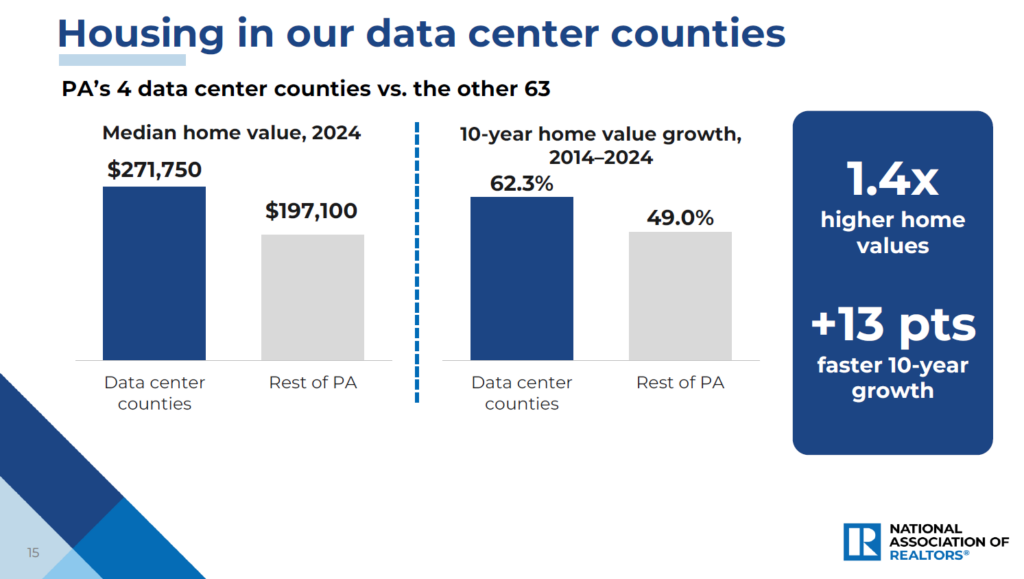
Again, association does not equal causation, as the four data center counties accounted for in Pennsylvania already had well-established economies.
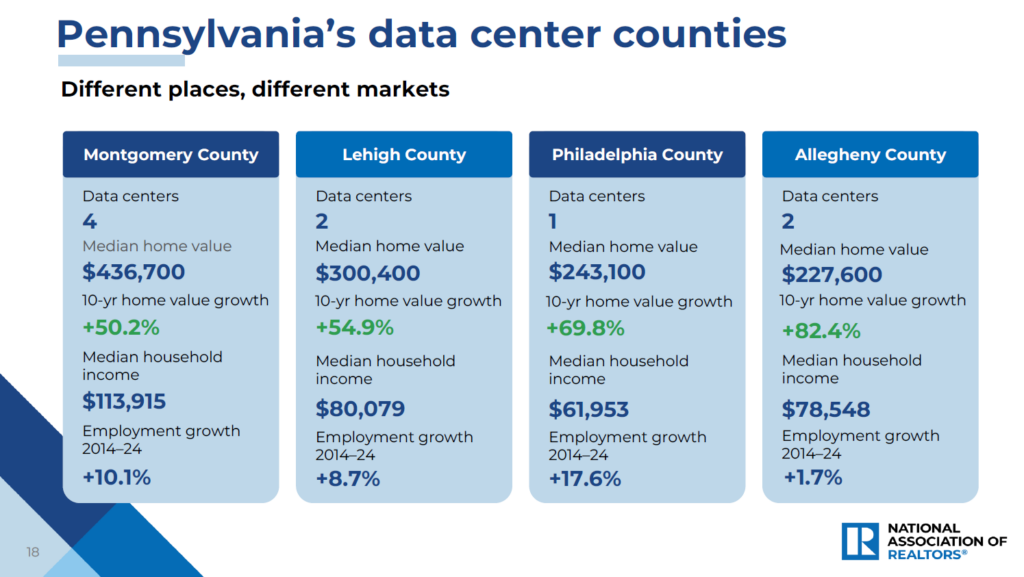
“Think about the counties we are talking about,” Evangelou said. “We have Montgomery, Lehigh, Philadelphia and Allegheny. These were already major populations and employment centers. That, I think, helps us explain why data centers were attractive to them in the first place.”
She noted that the Department of Energy projects 7-56 new data center sites in Pennsylvania by 2035.
More to Learn in Coming Years
Evangelou encouraged Realtors® to use NAR’s data to have more data-driven conversations, especially when the buyers have concerns about data centers. She stressed that the research does not indicate one way or the other how the housing market will be impacted in the coming years, and recommended Realtors® look at their individual markets and local market data.
“The next several years will be very important for you. You have the opportunities to stay close to the local data, understand what’s actually being proposed and help buyers and sellers separate what we know from what we assume, because you have the expertise and you can help them navigate these changing developments.”
Realtor® Clients’ Concerns Now
Christopherson presented further research on Realtor® clients’ perspectives on and concerns about data centers.
He noted that the biggest client concerns Realtors® reported were:
- Energy costs (65%)
- Water use (49%)
- Environmental contamination (42%)
“It’s very important to keep these in mind when you’re addressing this topic for yourselves and your clients to know that when you mention a data center, these are the top things that come to mind with your clients,” he told Realtors®.
Additionally, he added that the most common sentiments among clients were “not in my backyard” positions, that data centers are necessary and inevitable for AI and that they’re a strong investment.
Some Realtor® takeaways Christopherson concluded with included:
- Avoid broad national claims
- Distinguish among evidence types
- Don’t confuse association with causation
- Use reliable local information and expertise
Hear More From Evangelou and Christopherson
Evangelou and Christopherson shared more about the data behind data centers. View the webinar recording on PAR’s website.
Last week, PAR welcomed Tom Beresnyak from Penn State Extension’s Energy Team, who spoke on a webinar about Pennsylvania being an attractive location for many developers. Read the recap in this JustListed article or watch the webinar recording here.
Topics
Member Discussion
Daily Emails
You’ll be the first to know about real estate trends and various legal happenings. Stay up-to-date by subscribing to JustListed.
