
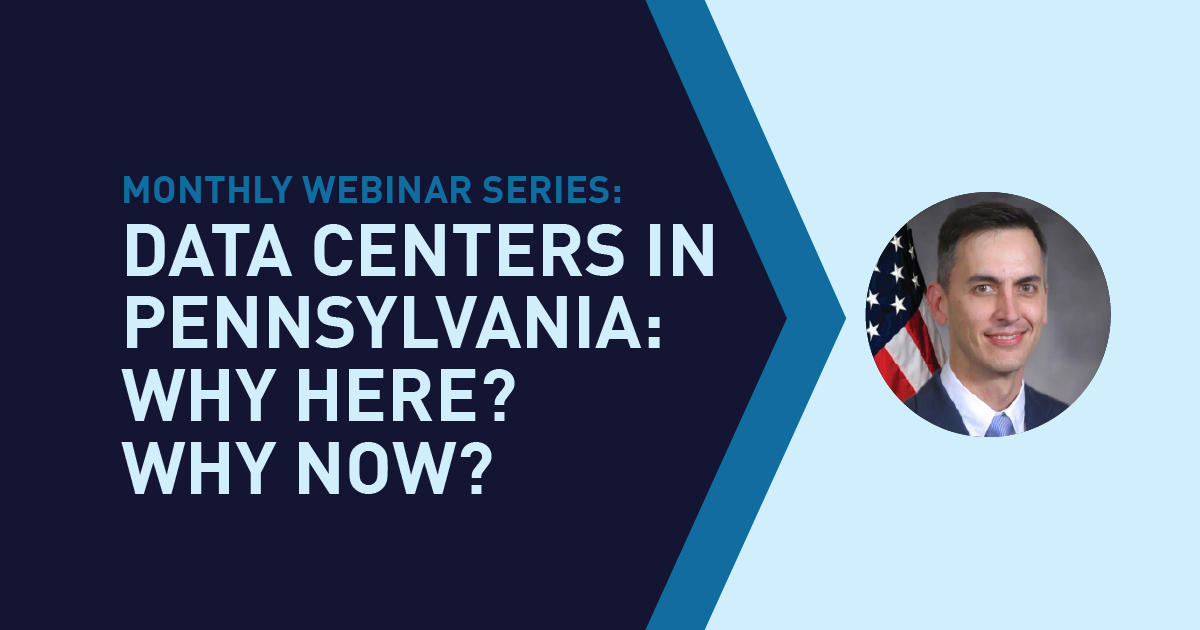
As AI booms, data centers are popping up more frequently across the country, and Pennsylvania is an attractive location for many developers. PAR welcomed Tom Beresnyak, senior educator with Penn State Extension’s Energy Team, on a webinar yesterday about data centers in Pennsylvania.
What are data centers?
Beresnyak explained that data centers power the modern digital world, from streaming movies and music to training and running AI models. As generative and advanced AI have gained more ground, the need for power has increased. In response to the demand, more large-scale data centers have been built and planned across the country.
Hyperscale data centers, which are what many people think of when they think of data centers, measure anywhere from 50,000 to 1 million square feet, using 100-1,000+ megawatts, even into gigawatts. For reference, Beresnyak shared that the city of San Francisco alone requires one gigawatt of power per day. These data centers power things like the Google Cloud, AI training, social media training and more.
What do these data centers look like?
“Rows and rows of server racks and computing equipment with some sort of subfloor for an enormous amount of cabling to keep all of those computers connected,” he described. “It would probably look like a normal type of larger warehouse, except you would see a lot of HVAC equipment or chillers around the building.”
Why Pennsylvania?
Research has projected an astronomical increase in data center power requirements. Pennsylvania has power, making the state an attractive location for many developers.
“Pennsylvania really is a natural powerhouse in energy production,” Beresnyak noted. “We’re number two in natural gas and number three in coal production. We have the largest natural gas storage capacity here in the country.”
“If you want to produce gigawatts of power, you’re looking for natural gas, and we’re centrally located within a very large basin,” he added, referring to the Appalachian Basin, which is the second largest single natural gas producer on the planet. The U.S. is the largest natural gas producer by country overall.
He noted that Pennsylvania and the Northeast also have access to more water than some other regions of the country, which can play a role in location consideration as well.
In general, the places that are most attractive for large-scale data center developers are located at the intersections where gas, major electrical infrastructure and internet infrastructure meet.
What is the future of data centers in Pennsylvania?
Beresnyak reported that there are currently 78 operating data centers in Pennsylvania, with another 51 planned. They’re more concentrated in the Pittsburgh and Philadelphia regions, with additional development in the central/eastern parts of the state. For the most part, they’ve followed population trends thus far.
Additionally, the state has made a $20 billion capital investment in nuclear-powered AI infrastructure, and there are plans to repurpose the Coal Region for the AI boom.
Policy-wise, Beresnyak added that Gov. Shapiro’s GRID Requirements ensure that data center development in Pennsylvania protects the energy grid, the environment and local community interests, and some local governments throughout the state have used Community Benefits Agreements to mitigate data center impacts and secure financial benefits.
How do data centers impact real estate?
Beresnyak briefly touched on the effects of data centers on real estate, including economic growth, increased property values, reduced vacancy rates and modest residential growth, citing the National Association of Realtors®.
Learn more about the real-world impacts of data center growth and the latest research on housing, jobs, energy and real estate next week, during PAR’s webinar “The Data Behind Data Centers.” NAR’s Nadia Evangelou and Matt Christopherson will examine national trends and Pennsylvania-specific data related to data center development.
Hear More From Beresnyak
Beresnyak also discussed types of AI, data center emissions, community concerns, infrastructure considerations and more. Learn more by watching the webinar recording on PARealtors.org.
Topics
Member Discussion
Daily Emails
You’ll be the first to know about real estate trends and various legal happenings. Stay up-to-date by subscribing to JustListed.
